I live in the USA and I am concerned about the future. I created this blog to share my thoughts on the economy and anything else that might catch my attention.
This is the End and a New Beginning
-
I've been thinking about this for some time.
After 21 years of writing this blog almost daily, I've decided to stop
writing the daily updates on the blog.
...
Silver Deep Dive
-
Silver had a memorable year (+148%). Some of this can be explained by a
decline in the dollar. I decided to do some ML analysis to look for other
insights....
To me that's a recipe not for an explosion upward but for a range where Europe kills us one day but we are brought back to life by China and by broader trends that won't quit, trends including better-than-expected earnings on top of lowered estimates and the gloom that shrouds all.
Europe kills us and then we are brought back to life by China? Seriously?
And if there is one way to describe Zombieland, it is moist. There are all sorts of unwanted fluids (liquidity) everywhere.
“I’ve always enjoyed my customers, but some things have been happening over the past 2 to 3 years that just led to closing it. I’m actually happy about it. I’ve been kinda’ sick ... and I can’t take it no more,” Corbin said.
“We’ve got a buyer for it, but the restaurant will be gone. They’ll be tearing the building down,” he said.
Perhaps a presidential pep talk will inspire him to change his mind?
Who are you? Where do you come from? Are you listening to me? What do you want to do with your life?
The following chart shows the increase in prices of various food items since 1947 relative to what prices overall have done.
I find it interesting that fish and seafood prices rose during the 1970s relative to most things and never came back down. The same cannot be said of meats.
In anticipation of this post, fried has offered the following link (from the comments of the last post).
Elliott Norse, president of the Marine Conservation Institute and the paper’s lead author, said the world has turned to deep-sea fishing “out of desperation” without realizing fish stocks there take much longer to recover.
“We’re now fishing in the worst places to fish,” Norse said in an interview. “These things don’t come back.”
For what it is worth, I have a very large supply of canned tuna fish in my extended pantry. Unlike meats, it does not even require refrigeration.
Japan has spent decades developing and refining highly advanced fish-farming techniques. In September 2004 many of those efforts came to fruition when the first consignment ever of farmed bluefin tuna, a fish that fetches extremely high prices, was shipped commercially. In a related development, a major supermarket has announced plans to sell flounder that has been farmed without the use of antibiotics. The technology of fish farming, a practice that offers advantages in terms of food safety and conservation, is advancing rapidly.
Aquaculture continues to be the fastest-growing animal-food-producing sector and to outpace population growth, with per capita supply from aquaculture increasing from 0.7 kg in 1970 to 7.8 kg in 2008, an average annual growth rate of 6.6 percent.
iShares Barclays TIPS Bond Fund (NYSE:TIP) defies analysts with a current price ($115.85) 100.0% above its average consensus price target of $0.00.
Yes, indeed. Even if TIP currently traded at a penny it would infinitely defy the analysts, lol.
Now I'm not suggesting that TIP couldn't fall from here. It definitely could. I have chosen to park money in an online savings account rather than risk parking it in the fund (for money I need in the next few years).
That said, there is clearly an error in the analysis. The author of this article did not find a $0.00 consensus price target to be even a bit odd? How is that possible?
It is a sardonic comment on the tendency to put excessive trust in "computerized" data, and on the propensity for individuals to blindly accept what the computer says. Because the data goes through the computer, people tend to believe it.
In my opinion, this term also describes our banking system fairly well. Banks tell their computers that the assets on bank balance sheets are pristine and proper and then the computers inform us that the assets on bank balance sheets are pristine and proper. Garbage in, garbage out.
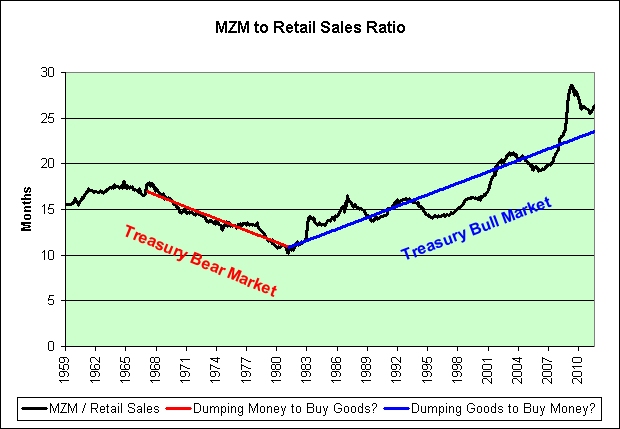
There's a lot that could be said about this chart. Rising income inequality? China dumping their goods on us for our money? The tanking real estate market? Our credit bubble? Financial repression?
I don't think the treasury bull market will last forever, but predicting its demise has beena bit trickyto say the least. Never a better time to short treasuries?Oops.
I was rather indifferent personally. I thought real yields would continue to fall and they have (just like the 1970s). I had little opinion on nominal yields though. 1970s? Japan? You tell me and we'll both know.
Those buying and holding today's 10-year 0.0% TIPS will lose purchasing power after taxes. If the bull market continues it sure won't feel like it.
That said, take a look at global short-term real yields as seen in the chart in the following link though. You could potentially do worse.
A look at average real short-term policy rates over the past 15 years shows how extraordinary the current environment is (see Chart 1). By this metric, the entire world is, on average, running a very repressive interest rate policy. Even the majority of emerging market countries are holding rates abnormally low compared with inflation and growth trajectories.
I'm about out of "safe" advice for the constitutional saving peasants. We're being oppressed. The central banks of the world are desperately attempting to get us to embrace risk at exponentially increasing levels. My idea of risk taking was buying long-term TIPS, I-Bonds, canned goods, and toilet paper on the hopes I would do it before others did. I'm not exactly sure that's what our superiors had in mind.
I'm using a crude simplistic model as an attempt to understand the movements of our liquid money supply (MZM).
I assume that MZM grows naturally based on the rate of three month treasury bills and use the past 12 months of data to predict where we should currently be (assuming no inflows or outflows). I then compare where we are now to that prediction.
Using this model as a guide, investors lacked confidence over the past decade. Can't say I blame them.
I included some of the more major economic events on the chart. I've no doubt missed quite a few. For example, theCuban Missile Crisis (1962)was certainly worth mentioning.
I would define an investment as an asset that creates value and income over time. Stocks, bonds, real estate, even livestock and some machinery for businesses would all qualify.
1. The asset must create value and income over time. 2. Bonds qualify as an investment. 3. TIPS are bonds, therefore TIPS are an investment. 4. The real yield on 5-year TIPS is negative. 5. 5-year TIPS cannot create value and income over time, therefore 5-year TIPS cannot be an investment.
Using this article's own definition of an investment, 5-year TIPS are an investment and are not an investment.
Clearly there is a serious logic problem in the author's definition of investment.
Don't even get me started on the lack of value creation and income generation of stock and real estate investments since I started this blog.
Myth busted? Hardly.
Myth #2: Gold is a store of value
This is an easy one. Is gold a store of value? Absolutely.
As long as gold doesn't fall to zero dollars then it will store at least some value. Even a cracked glass can be a store of water (as long as you don't fill it above the crack).
Greenspan said in 1966 that there can be no "safe" store of value in a welfare state. Is gold a safe store of value? No, but nothing is.
Is gold a good store of value at these price levels? I don't believe it is over the long-term but I could be wrong.
Even if it was the author's intent to suggest that gold is not a good store of value at these prices levels and/or over the long-term, then it is still impossible to bust the myth based solely on personal opinions.
Myth busted? Hardly.
Myth #3: Gold is a contrarian trade
This claim is almost laughable, but it wasn’t born in a vacuum.
Laughable?
The totalmarket capitalizationof all publicly traded companies of the world was thought to be $51.2 trillion in 2007 and just $40 trillion in September 2008. Note the $11.2 trillion decline.
Gold represents roughly 5.4% of the total ($51.2 trillion + $109 trillion + $9.2 trillion). Further, stocks lost more value from 2007 to 2008 than the value of all the gold that's ever been mined. It could easily happen again.
That's not even counting the trillions upon trillions of dollars in global real estate ($18 trillion just in household real estate assets in the US).
If one is seriously concerned about the state of the global stock markets, global real estate markets, and global debt markets then I think it could be easily argued that gold is still a contrarian trade.
Myth busted? Hardly.
On the one hand, I think gold is mighty expensive compared to toilet paper. I think that is a huge red warning flag.
On the other hand, I do not agree with the author's conclusion that the "gold’s bull run is based on weak arguments that don’t hold up to scrutiny." From where I stand, none of his three supposed myths hold up to scrutiny.
If holders of long-term treasury inflation protected securities (such as myself) experience serious pain, then hindsight will more than likely show that gold was a bargain even at these levels. The emphasis is on the word "if" though. Only in hindsight will we know for sure.
The following chart shows what an investor can expect to earn by buying today's 0.9% 30-year TIPS and holding it until maturity.
Note what the combination of high inflation rates and high tax rates does to TIPS performance. Inflation protected securities offer pretty good protection but only if inflation doesn't get seriously out of hand.
Although TIPS investors would be doing much better than nominal treasury investors in such an environment, there would still be pain if inflation picked up (due to the taxation of the inflationary gains each year). The greater the inflation rate, the greater the pain.
As a TIPS investor who holds TIPS to maturity, I am fairly well protected against a 1970s style inflationary environment that never ends (7.5% per year inflation). I am not well protected against hyperinflation. Gold investors are much better protected should that happen. The risk is not trivial but it is one I am willing to take.
I personally think gold is in a bubble and that it is unsafe to be investing in it at these levels (with the caveat that I don't think anything is safe right now, other than toilet paper and basic necessities). It is just an opinion though. I certainly cannot prove it beyond a reasonable doubt. In other words, if gold was on trial here I would have to find it not guilty.
Update: Thanks to Troy for pointing out that the $18 trillion in real estate was just the household real estate assets, not all land value. I should definitely have made that more clear.


 Posts
Posts