Thursday, December 6, 2012

Wednesday, December 5, 2012

The Quote of the Year

November 21, 2012
Macau grapples with booming casino economy

“Macau is a complete illusion of prosperity because what we are building is only casinos, rooms and some shops with famous brands,” said lawmaker Jose Coutinho.

Good thing we know better!

Quote of the Day

December 4, 2012
Olive Garden parent cuts view on restaurant sales drop

Darden's promotions did not "resonate with financially stretched consumers as well as newer promotions from competitors", Otis said in a statement.


Monday, December 3, 2012

The Health of Retail Trade Employment

First, let's go with what we are told.

BLS: Retail Sales Workers: Job Outlook

Employment of retail salespersons has traditionally grown with the overall economy, and this trend is expected to continue. Population growth will increase retail sales and demand for these workers.

Although consumers are increasing their online retail shopping, they will continue to do most of their retail shopping in stores. Retail salespersons will be needed in stores to help customers and complete sales.

Now that we've read that and have no doubt turned optimistic, let's go look at some actual charts to back the theory.


Click to enlarge.

Oh, yeah. That's looking real good long-term. We're not done yet though. Let's keep digging.


Click to enlarge.

When it comes to hours worked per week, we never did bounce back from the 1970s.


Click to enlarge.

Did I mention that we never did bounce back from the 1970s? Further, it would seem we've recently been attempting to duplicate the effect with high real oil prices and the added bonus of increased retail automation.

As seen in the following link, we apparently have some of the most educated retail workers in the history of our country. And yet, real hourly earnings have declined and continue to do so. If this isn't an illusion of prosperity then I don't know what is.

July 08, 2012
College Grads Find Retail a (Meager) Route to Job Market

Students with advanced degrees have been unable to find jobs consistent with their skill set, leading to a heavy influx of overqualified young people in retail positions that typically require no more than a high school diploma.

Source Data:
BLS: Current Employment Statistics
St. Louis Fed: CPI

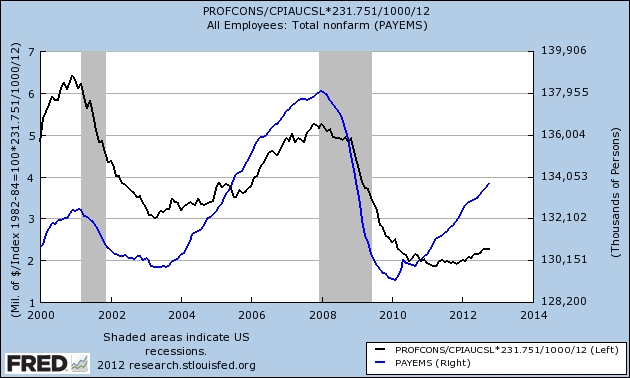
Real Office Construction per Employee Added


Click to enlarge.

The line in black shows the money spent on office construction per month adjusted for inflation (October 2012 dollars, in billions). If one adds up all the monthly data and adjusts for inflation, there has been $588 billion spent on office construction since the year 2000.

The line in blue shows nonfarm payrolls. There have been 2.97 million employees added since 2000.

Since 2000, $198,000 has been spent on office construction per nonfarm payroll job added.

$588,000 million / 2.97 million = $198,000

Using hindsight, does that appear to be money well spent?

On the one hand, not every payroll employee added actually works in an office. On the other hand, not every office building that existed in 2000 still exists today. Sigh.

Is it really any wonder that office construction has been in a downward trend for the last decade or so? When job growth began to fail, so too the need to build new offices.

Source Data:
St. Louis Fed: Custom Chart

Sunday, December 2, 2012

Fake Prosperity?


Click to enlarge.

Update:

Rob Dawg wished to see an exponential trend from 1961 to 1991.


Click to enlarge.

The chart above sums up why there was a question mark in my first chart. If the true trend is an exponential growth curve then we're right on trend for the most part. I just find it hard to believe that the dotcom bubble and the housing bubble got us there.


Click to enlarge.

And lastly, this chart captures the spirit of Rob Dawg's point. It's a fairly good fit. If this is the true trend then there is a bit more fake prosperity than the first chart shows (since the true long-term trend would be bending downwards).

Source Data:
St. Louis Fed: Custom Chart